

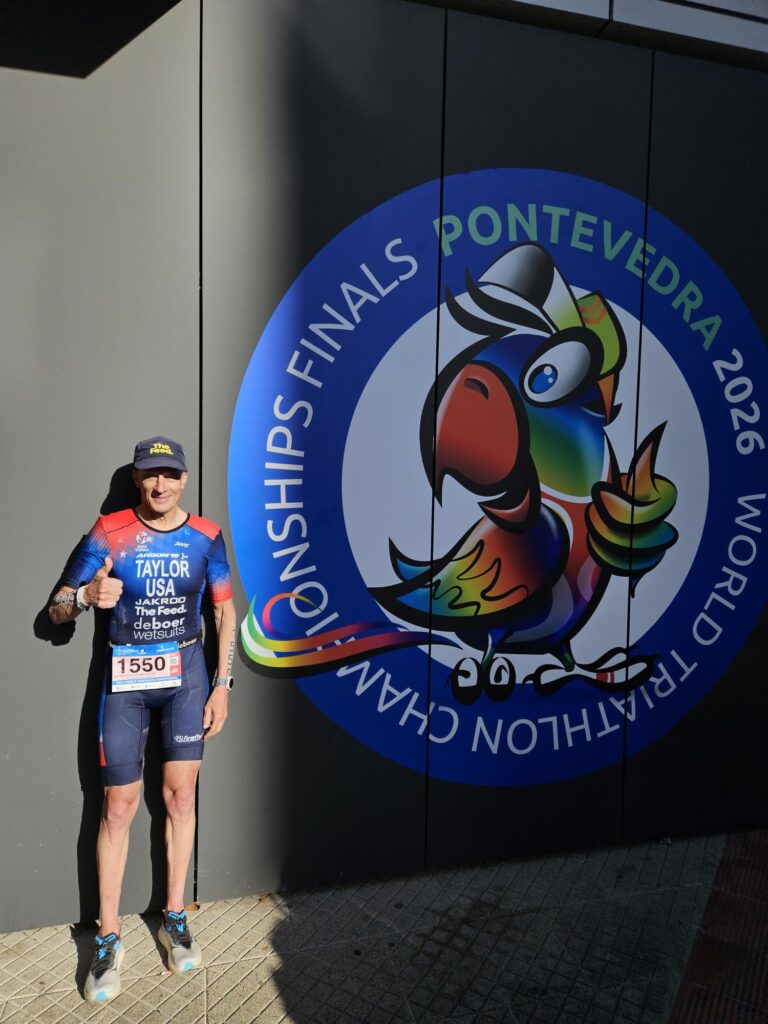
With the World Championships in Spain firmly in my rearview mirror, my 2026 triathlon season is now officially over. By all counts, it was another successful year in a “career” that has spanned 25 years (with an 11-year break):
- Two more National Championship titles (seven total now).
- On the podium in five of six National Championship races (fourth in the other).
- At the World Championships, 13th out of 83 in the Sprint and sixth out of 25 teams in the Mixed Relay.
It was a season in which I experienced considerable joy, excitement, and pride. But I also felt anxiety, worry, and disappointment. Those results give me plenty to feel good about, yet they don’t capture everything that went into the season or everything I felt along the way. As much as I would like to say that I always appreciate what I accomplish, I can still find myself paying more attention to the athletes ahead of me than to the race I actually had.

An Existential Crisis

Toward the end of the season, I experienced an existential crisis in my triathlon life. I asked deep questions including: 1) Why am I doing triathlons? 2) Am I really enjoying triathlons? and 3) Do I really want to continue doing triathlons? These are uncomfortable questions when you have invested as much time, energy, and emotion in a sport as I have. But they are also questions worth asking, particularly when something I choose to do starts to feel like something I have to do.
I attribute much of my existential crisis to the fatigue that builds as the end of the season approaches. There is the physical fatigue, of course, but also the mental fatigue of following a training program, preparing for races, managing expectations, and caring so much about how I perform. By the end of a long season, even something I love can feel like a burden.
A Key Lesson
One lesson I need to remember is that the end of the season may be a good time to ask these questions, but it may not be the best time to make final decisions about the answers. A tired body and mind can color how I see both the season behind me and the one ahead. Only two weeks removed from Worlds, I’m back to training and already thinking about 2027. That renewed interest tells me something, too.

The upcoming three-month period before I begin formal and structured training for the 2027 season has begun. During this time, I’m planning to stay very active, but not adhere to a strict training program and only do workouts that I enjoy (e.g., long rides with lots of climbing). My biggest rule during this period is: If I don’t feel like doing a workout, I don’t do the workout.
Of course, knowing me, “taking it easy” will still involve plenty of exercise. The important difference is having the freedom to choose what I do based on what I want that day. I want to finish this period feeling eager to train for another season. I also want to give myself permission to enjoy a workout without needing to explain how it will make me faster. A long ride can be worthwhile simply because I love being on my bike and climbing a beautiful road (which there are plenty of where I live north of San Francisco).

The 2027 race season is going to be challenging for me because I’m in my last year of my age group. As I have learned this year, at my age, there can be a big difference between “newbies” in my age group and those like me who are four or five years older. This acknowledgment will, hopefully, help me temper my expectations for the season.

At the same time, I don’t want to use my age as an excuse or decide in advance what I can’t do. I still want to prepare well, compete hard, and give myself the opportunity to have some great races. The challenge is to be realistic about the athletes I’m racing against while remaining open to what I may be able to accomplish. Moderating my expectations doesn’t mean that I have to stop being ambitious.
Questions to Ponder
I’m now in a period of reflection and evaluation. I’ve been asking myself questions such as:
- What is my why in triathlon, and is it healthy?
- What are realistic goals for 2027?
- What are my strengths (preparation, running, transitions)?
- What areas do I need to work on (nutrition, swimming, biking)?
- What worked in 2026 that I want to keep doing?
- What didn’t work in 2026 that I need to stop doing?
- What do I need to do differently in 2027 that will enable me to continue to improve and be competitive?
- What parts of training and racing gave me the most enjoyment, and how can I make more room for them?
- How do I want to feel about my season when it is over, regardless of my results?
These questions need to lead to more than the familiar conclusion that I should work harder. I’m already pretty good at working hard! The more useful question may be where my effort will make the greatest difference. That includes taking nutrition and recovery as seriously as the workouts themselves, and recognizing when another hard session may be less helpful than being rested enough to benefit from the work I’ve already done.

Hard-to-Accept Realizations
I’ve also had to consider accepting some realizations that are uncomfortable, but may be necessary if I’m going to continue to enjoy our sport. Three come to mind.

First, I may never get faster in the swim or bike. I didn’t grow up swimming and, despite my best efforts, it continues to be a liability, often coming out of the water minutes behind and playing catch-up. As for the bike, I weigh only 137 lbs. and, again despite my best efforts, lack the power to ride with the strong cyclists to the point where I can’t even keep up with them in draft-legal races.
Accepting that possibility is difficult because I like to believe that if I put in the work, I will improve. Yet effort doesn’t guarantee the improvement I want, particularly at this stage of my athletic life. I still intend to work on both disciplines. But I may need to recognize progress in smaller gains, greater consistency, or being better able to use the fitness I have on race day. And if I’m able to maintain my speed as I get older, I need to consider whether that deserves more credit than I tend to give it.
Second, without my running and fast transitions, I would be just an above-average triathlete. That realization can feel discouraging when I focus on what I lack. But I also have to remind myself that running and transitions are part of triathlon! They count just as much toward my finishing time as the time I lose elsewhere. I don’t need to discount my strengths simply because I wish my weaknesses were stronger. Part of preparing for 2027 will be continuing to develop what I do well while trying to reduce the cost of what I don’t do as well. Overall, as I often tell people, at my age, the goal is not necessarily to get faster (that’s just not going to happen!) but to slow down more slowly than everyone else.

Finally, because of these liabilities, I may never be truly competitive against the former pros and other genetic freaks that seem to populate every age group. And I may never realize my dream of winning a world championship title.
That last possibility is particularly hard to accept. A world title is a dream that motivates me and gives my training purpose. I don’t feel a need to abandon it. But I do need to ask how much influence I want that dream to have over my enjoyment of our sport. If winning a world championship becomes the only outcome that will satisfy me, I could dismiss years of meaningful experiences and accomplishments because of one result I never achieved. I would hate to look back on my triathlon life that way.

Perhaps most importantly, I need to ask myself why I do triathlons and whether those whys are healthy and result in my enjoying our sport enough to keep going. My fundamental whys include: 1) I love training and being healthy and fit; 2) I love to compete; and 3) I love to see how I stack up with the best in the U.S. and the world. The challenge of the latter two whys is that they can and have led me to some unhealthy whys that focus too much on results and comparison. Coming to terms with these conflicting whys will be essential to my continuing to find meaning, satisfaction, joy, and just plain fun in triathlon.
I don’t think loving competition or caring about results is inherently unhealthy. I wouldn’t devote this much to triathlon if competing didn’t matter to me. The problem arises when where I finish has too much influence over how I feel about myself or whether I consider the whole experience worthwhile. I want to be disappointed when I fall short of a goal without allowing that disappointment to erase everything else that was good about the race or the season.
That means giving myself more than one way to have a successful 2027. Results will certainly be one measure. So will preparing in a way that I feel good about, making sound decisions during races, competing with the determination I expect of myself, and executing to the best of my ability on that day. Enjoying the day-to-day experience also needs to be a measure including appreciating the wonderful people who make triathlon such a vibrant community. Most of my triathlon life happens between races, and I don’t want to spend all of that time waiting for a result to tell me whether it was worth it.
As many of you know, I’m a mental coach who helps triathletes be in a good space psychologically and emotionally. One challenge is that it isn’t always easy for me to practice what I preach. Having a process focus, owning healthy whys, maintaining a reasonable level of investment, and not getting too absorbed in my results are all lessons I impart to the athletes I work with. But it’s an entirely different thing to hold myself to those standards because, though I may know what’s good for me, as a human before a mental coach, I’m as susceptible to unhealthy forces as anyone.
Knowing these lessons doesn’t prevent me from getting caught up in the same struggles. It does give me a way to recognize what is happening and, hopefully, make some adjustments. I also need to remember that practicing what I preach includes how I respond when I fall short. Expecting myself to have a perfectly healthy perspective all the time would create another unreasonable standard to chase.
One thing that I’ve promised myself is that I will continue to hold myself to those same standards so I, too, can gain the benefits of being a competitive triathlete. That means continuing to ask these questions during the season, when the answers can influence my choices, instead of waiting until I’m exhausted at the end of it.
In any case, for the time being, I’m not going anywhere, and I plan to both enjoy the 2027 season and continue to challenge myself to be the best triathlete I can be. I still have goals I want to pursue and areas in which I want to improve. I also want to arrive at the end of next season knowing that I enjoyed the work, appreciated what I accomplished, and wanted to keep coming back.
And aren’t those the best whys possible to do our wonderful sport?