

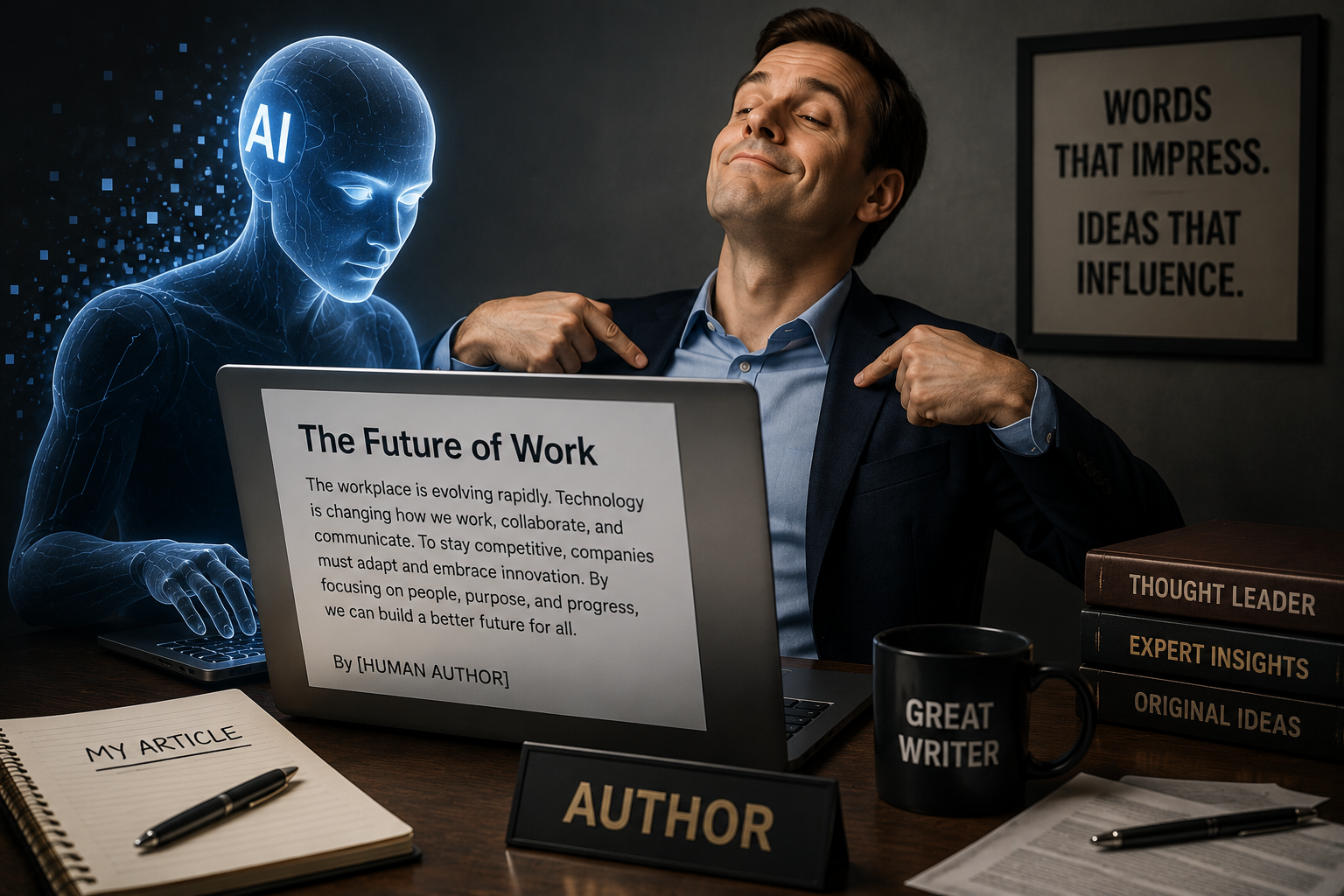
It’s happening more and more these days. I read an article or blog post that may or may not be interesting, but as I read it, something feels off, something is making me uncomfortable. Then, it hits me, I’ll bet AI wrote it.
How can I have reasonable suspicions when an article has been written by AI? Increasingly, I notice patterns that often suggest heavy AI involvement and produce what are for me some obvious “tells:”
- Writing created by humans is inherently imperfect. Grammar and sentence structure are inconsistent and lack uniformity. AI-written content tends to be perfect, the writing flawless, unless AI is prompted to write in a more human way.
- The rhythm and flow of the article feel robotic, often using the same phrases, transitions, and styles.
- One-sentence paragraphs and repeated three-word sentences.
- The overuse of em dashes. Rare is the human writer who uses em dashes so frequently, yet they are ubiquitous these days in AI writing.
- Writing by AI often feels emotionally flat; there just isn’t the feeling of a human behind it.
- If I have expertise in the subject of the article, I see the information as generic rather than a person’s own unique ideas.
- AI writing tends to be categorical and overly confident. There is often no uncertainty or hesitation or humility. No use of “perhaps,” “maybe,” or “might be.”
- There is an absence of personal insights, opinions, or self-critique.
- An AI generated article just feels soulless because there aren’t a human’s heart and mind behind it.
Also, just to test my AI-detection acumen, I’ll run an article through a few of the many AI detectors available online. Literally every single time, my suspicions are confirmed.
Admittedly, an experienced writer who knows how to use AI can help it to generate writing that mitigates these tendencies. But many AI writers don’t. The end result is that I feel like my time was wasted, even if the idea was good. Its value has been lessened because I’m a real human being reading it, shouldn’t a real human have written?
Don’t get me wrong. AI is a powerful tool to help us research, brainstorm, edit, organize, and revise. But when it replaces the difficult work of thinking, questioning, synthesizing, and developing a unique perspective, it doesn’t just diminish the writing, it diminishes the writer. My criticism isn’t about using AI; no doubt it can make us better thinkers and writers. But when we fully outsource our writing, we outsource our thinking. And the costs both individually and collectively are high.
In the end, you pay the price. Why? Because effective writing and, even more so, a successful career, aren’t grounded in co-opting others’ ideas or skills, even when those “others” are not human. They are certainly not gained by the absence of rigorous thinking or the presence of generic information.
I see several significant problems with AI-generated writing that, surprisingly enough, hurt the person using AI to write more than the recipients of that writing.
First, it’s intellectually dishonest. When you put your name on an article indicating that you wrote the article when, in fact, AI generated it in its entirety (or close to it), you’re just plain lying. It may have been your idea, but authorship isn’t just about who had the idea; rather, it’s about who actually wrote the article, chapter, blog post, or book.
A compelling perspective on this is that AI-generated content can’t be copyrighted, meaning it can’t be legally owned. Here’s what the U.S. Copyright Office has to say:
- Typing a text prompt into an AI generator to create an image or text does not make you the author of the output.
- You can claim copyright over an AI output if you creatively adapt, modify, or significantly edit it. However, copyright only protects the specific elements you added or changed, not the base AI-generated portions.
So, when you have AI write an article for you and put your name on it indicating that you are the author, you’re being dishonest about the authorship. It’s almost as bad as plagiarizing. The difference is that AI won’t threaten legal action.
Second, using AI to write for you is intellectually lazy. You may not have confidence in your capacity to think innovatively or write compellingly. Or you’re not willing to take the time or expend the energy to write the piece yourself. Or perhaps you simply lack the intellectual firepower or writing skills to do so, in which case, no matter how much content you generate, you will likely not parlay that content into professional respect or success.
Writing isn’t simply the expression of ideas. Rather, it is a powerful means of generating ideas. The simple act of putting pen to paper (metaphorically these days) forces us to wrestle with ideas, challenge our assumptions and beliefs, and consider alternative views. It causes us to process, interpret, integrate, and structure ideas in a meaningful way. This demanding process results in new and different ideas, ideas that are uniquely you. In a way, if you think of the mind as a muscle, the act of writing strengthens your intellectual muscles. The result? You become increasingly capable of “heavier lifts,” meaning you are increasingly capable of more complex ideas and better able to present them in equally more interesting ways.
Good writing and all the benefits that accrue are based on original thinking, creative ideas, and sound writing skills, none of which come naturally or easily. More specifically and more powerfully, it comes from generating thoughts, ideas, theories, and frameworks that are an expression of who you are, what you know, and what you believe. It involves building your own intellectual and creative scaffolding and forging your own unique identity (or brand, these days). In doing so, you develop a “voice” that is yours alone. And it is that voice, that expression of what makes you unique, special, and worthy of being heard and valued, that will set you apart from others and lead not only to success, but real meaning, satisfaction, and joy in your efforts.
You also pay the price in knowing, at least deep down, that you are cheating, not only others, but more so, yourself. You’re admitting your own inefficacy. One inadvertent and undesirable message you may be sending the world is that you are lazy, incapable, and unwilling to do the work necessary to make a meaningful contribution to the world. And that is no recipe for success.
You are, in essence, presenting yourself as a poseur, an imposter, a fraud. And, in doing so, you know you can’t truly “own” your accomplishments. It’s a form of “ghostwriting,” little different than having someone else write something that you take credit for. With this intellectual dishonesty, you may feel, at some level, guilt, embarrassment, and even shame because, no matter your self-justifying rationalizations, you’re presenting something to the world that is really not yours.
A final and ironic caveat. I tested my own article with four leading AI detectors. All concluded it was predominantly or entirely human-written. All of the so-called red flags that were highlighted were, in fact, written by me (I’ve noticed that my writing style has some of the same structural wording rules as AI). In my research on AI writing, I’ve learned that they aren’t always very consistent and there can be considerable variation depending on the AI detector that is use. These experiences reinforced another lesson: AI detectors aren’t infallible judges of authorship. If they cannot reliably identify genuinely human writing, then we should be cautious about relying on them to distinguish authentic thought from machine-generated prose. At the same time, as the saying goes, if it looks like a duck and sounds like a duck, it’s probably a duck.
Just to show that I’m practicing what I preach:
Disclosure: This post was written by Dr. Jim Taylor with assistance from AI.